
When you need a temporary power source for your job site or business facility, there are a few details to consider before renting a mobile generator. One of the most important details is determining how you will connect the generator and distribute the power. This article provides a basic overview of power distribution planning for rental generators to help you prepare for your generator rental.
1. Where will the generator be located, and what is the distance from that location to the electrical connection point? Answering this question can help determine the necessary power cable lengths for your temporary power need.
2. What is the voltage for the electrical loads to be powered? Mobile rental generators are often voltage-selectable, meaning they are equipped with a voltage selector switch to provide power for a variety of common voltage applications. In some situations, a transformer may also be required to supply the necessary voltage. Here are a few examples where a transformer might be needed:
- When two different voltages are required from one rental generator, such as 208 volts and 480 volts.
- If a voltage higher than 480 volts is required, such as 2,100 volts, 4,160 volts, or 13,200 volts. This would typically require a “step-up” transformer to supply these higher voltages since most rental generators in the U.S. are limited to an output of 480 volts.
- On occasion, an existing transformer onsite may need to be taken offline, which might require a temporary transformer to supply the proper voltage to the downstream loads.
3. Where is the electrical connection point to distribute the power, and how will the power cables be connected?
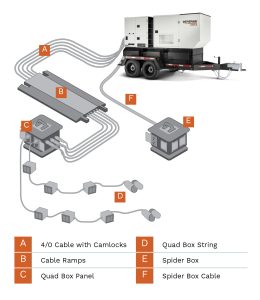
- If you are connecting to a building or facility with a pre-installed cam-lok connection cabinet, also referred to as a docking station or a quick-connect panel, the cable connections should be fairly simple; the power cables will plug directly from the generator to the connection cabinet using cam-lok plug/receptacle connections.
- If you are connecting to a building’s electrical system with no predetermined method to connect a temporary generator, this often requires a licensed electrician to temporarily connect the generator power cables using bare-ended cables at an electrical connection point in place of utility power, such as a main disconnect or sub-panel.
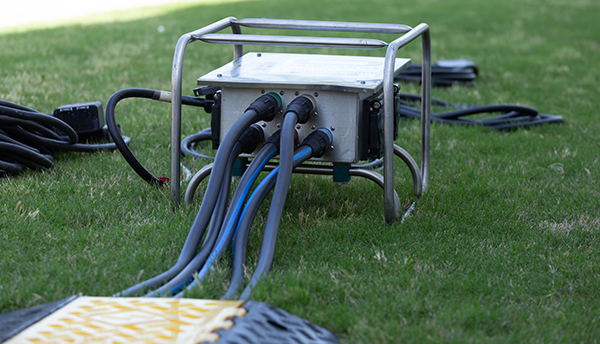
- If you need to run power to a single distribution point for a job site or event, a Spider Box might be a good solution. Spider Boxes provide multiple power receptacles built into a single panel, often with a combination of twist-lok receptacles and 120 volt duplex receptacles.
4. Does your job site or event require multiple points of power distribution?
There are many ways to provide the necessary power to the proper areas. Here are two common options:
- Distribution Panels provide the capacity for further power distribution into multiple areas, with an assortment of options to serve power to the connection points.
- Quad Strings are essentially power cables with duplex receptacle boxes spaced at specific lengths along the cable, providing 120 volt distribution to multiple areas.
This diagram provides examples of some of the power distribution equipment mentioned above:
If you have questions about power distribution for your temporary power need, one of our Power Rental Representatives can help design a power distribution plan to fit your power needs and area layout. We provide comprehensive power rental solutions for any event, including generators from 25 kVA to your maximum power requirement, with cable and distribution equipment to deliver power precisely where you need it.
For more information about generator and power distribution rental, see our Rentals page.
Clifford Power Systems, Inc. provides dependable generator equipment, service, and rental. We are solely focused on power generation and offer professional consultation to meet all your project needs. Contact us at any of our locations in Oklahoma, Texas, Missouri, Kansas, or Arkansas.

 Clifford Power is an authorized Generac® Industrial Energy dealer.