
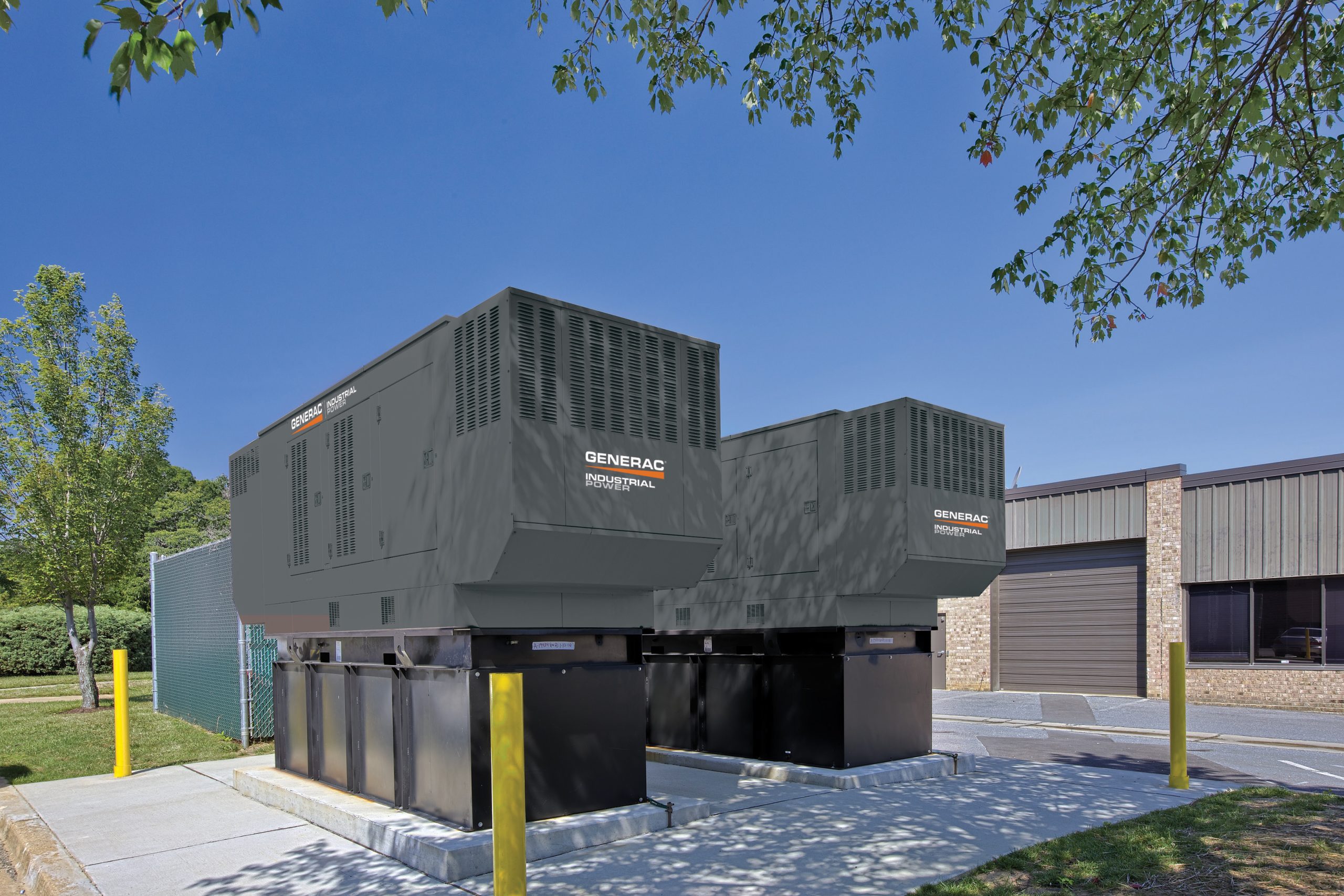
When selecting a standby power system for a business or facility, many clients want to know the benefits or potential drawbacks of paralleling multiple generators compared to purchasing a single generator. This topic discusses industrial generator paralleling and how to determine if it makes sense for your generator application.
The definition of paralleling is: consisting of or having parts connected in parallel: a parallel circuit. In the case of generators, this translates to the operation and connectivity of two or more generators to create a larger capacity.
There are three primary reasons for paralleling generators.
1. The load required is larger than any single engine can provide.
Today the largest single engine 1800RPM, 60Hz generator set rating is somewhere between 3,200 and 4,000 kilowatts. Conversely, by combining multiple generators in a paralleling system the kW capability is virtually endless. For example, if a facility requires 10,000kW of power, it will likely have to have multiple generators to accommodate the load. In this application, five 2,000kW generators paralleled would be a typical design.
2. Cost of the equipment and the cost per kilowatt.
For large generator applications, the cost per kW can be much higher when using a single engine as compared to paralleling. The reason is the engine represents 65% of the cost of a generator set. When we look at the economics of generator paralleling, the greatest benefits are those designed with diesel engines that are also used in heavy-duty trucks. Likewise, when we look at the economics of generator paralleling for gaseous fueled applications, the greatest benefits are with systems designed with gas engines used in cars. This is because these engines are mass-produced. Engines that are larger than these universal applications tend to come with an expensive price tag since fewer are produced.
The diesel engine cost per kW increases significantly above 600kW because mass-produced truck engines are typically used in generators that produce less than 600kW. For example, a 1,000kW generator typically costs more than two 500kW generators in parallel. There is also a significant cost per kW increase for generators over 2,000kW due to the increased engine cost. If a client requires 3,200kW they would recognize savings by using two 1600kW or four 800kW generators.
Similarly, the gaseous engine cost per kW increases above 150kW because automotive-style engines are typically used in generators that produce less than 150kW. Above the 150kW range, heavy-duty industrial diesel engines are modified for gaseous fuel applications. If a client requires a 300kW gaseous fueled generator, there could be a substantial cost per kW savings by utilizing two 150kW generators instead.
In some instances, paralleling generators can increase the cost. This could be related to the cost of installation, which could be less expensive or more expensive, depending on the application and the number of generators. Additionally, a system with multiple generators might require more physical space than a single generator. If this is the case, another benefit of using multiple, smaller generators, is having the flexibility to optimize space by locating generators on rooftops, parking lots, or garages – locations that would typically not be suitable for a single, bulky generator.
3. Systems requiring higher reliability or redundancy.
Imagine having an early morning airline departure, you jump in your vehicle to head to the airport and the battery is dead. If you have a second vehicle, no problem! Just switch vehicles and deal with the battery issue later. If you don’t have a second vehicle, you could have a problem. This same logic applies to multiple sets of paralleled generators. Let’s assume there is a 1,200kW system that consists of three 400kW generators, with an actual load of 240kW. One of the generators has a dead battery. No problem! Two engines fire up and take the load. Now assume there is a single engine 1,200kW system that has bad batteries and will not start. That is a total failure versus a partial failure on the parallel system.
In the same system with three 400kW generators (1,200kW capacity) with a load of 1,000kW, but only two engines start, the remaining 800kW is not enough to power the load. This scenario is a challenge, but if properly designed it could be manageable by shedding some of the non-essential loads. Non-essential loads might be half of the lights, motors, or temperature controls of the facility. This is typically planned during the design stage.
Critical systems such as data centers will typically be designed to accommodate the full load plus an additional generator for redundancy to ensure the reliability of operation. A backup power system that meets full load with an additional generator is represented as N+1. In the case of a system that meets full load plus two additional generators, it is represented as N+2. So with the same scenario of a 1,200kW with an N+1, this would take four 400kW generators for a total capacity of 1,600kW, or for an N+2, it would take five 400kW generators for a total capacity of 2,000kW.
Clifford Power is an authorized Generac Industrial Power dealer. For more specific features and benefits on Generac Modular Power Systems with integrated paralleling capabilities, visit: 6 Benefits of Generac Modular Power Systems (MPS) – Generator Paralleling
Clifford Power Systems, Inc. provides dependable generator equipment, service, and rental. We are solely focused on power generation and offer professional consultation to meet all your project needs. Contact us at any of our locations in Oklahoma, Texas, Missouri, Kansas, or Arkansas.

 Clifford Power is an authorized Generac® Industrial Energy dealer.